
NAD+ has become an increasingly popular subject in peptide and laboratory research, particularly in studies involving cellular energy, metabolism, mitochondria, DNA repair, and aging. But despite often being discussed alongside peptides, NAD+ is not actually a peptide.
NAD+ stands for nicotinamide adenine dinucleotide, a molecule naturally found in virtually every living cell. It plays an important role in many of the chemical reactions that allow cells to function.
So why are scientists so interested in NAD+?
The simple answer is that cells depend on NAD+ for some of their most basic processes. Researchers are studying how NAD+ is involved in cellular energy production, mitochondrial function, DNA maintenance, metabolism, and the ways cells respond to stress.
In this article, we’ll break down NAD+ research in everyday language, explain why scientists study it, and separate what researchers actually know from some of the much bigger claims commonly made about NAD+ online.
What Does NAD+ Do?
NAD+ plays an important role in the chemical reactions cells use to make and manage energy.
A simple way to think about it is to imagine each cell as a tiny factory. That factory needs energy to operate, and it also needs systems that help move that energy from one process to another. NAD+ is part of that system.
One of its main jobs is to accept and transfer electrons during chemical reactions. In the process, NAD+ can be converted into another form called NADH. These two forms work together as part of the cell’s energy system.
This is especially important in the mitochondria, the structures inside cells that help convert nutrients into usable energy.
It is important to understand that NAD+ does not simply “give you energy.” From a research standpoint, it is more accurate to say that NAD+ is one of the molecules cells rely on during the chemical processes involved in energy production.
NAD+ and Mitochondria
Mitochondria are often called the “powerhouses of the cell” because they help convert energy from nutrients into a form that cells can use.
NAD+ plays an important role in this process. As NAD+ and NADH move between their different forms, they help transfer electrons through the chemical reactions involved in cellular energy production.
Researchers are interested in this relationship because mitochondria do much more than simply produce energy. They are also involved in cellular signaling, metabolism, and the way cells respond to changing conditions and stress.
By studying NAD+ and its relationship with mitochondria, scientists can better understand how cells produce energy and what happens to these processes when cellular conditions change.
This connection between NAD+ and mitochondrial function is one of the major reasons NAD+ continues to receive significant attention in laboratory research.
NAD+ and DNA Repair
DNA contains the genetic instructions cells use to function. Over time, DNA can be affected by normal cellular activity and different forms of stress. Because of this, cells have their own systems for detecting and responding to DNA damage.
NAD+ is involved in some of these processes.
One important example involves a family of enzymes called PARPs, or poly(ADP-ribose) polymerases. Certain PARP enzymes use NAD+ while participating in the cellular response to DNA damage.
In everyday terms, you can think of DNA as a massive biological instruction manual. Cells have molecular systems that help protect and maintain that manual, and NAD+ is involved in some of the machinery those systems use.
This does not mean that NAD+ simply “repairs DNA.” The actual process involves many different enzymes and biological pathways. Researchers study NAD+ to better understand its role within these complex cellular systems.
What Are Sirtuins and Why Do Researchers Study Them?
Sirtuins are a family of enzymes that help regulate a variety of processes inside cells. What makes them especially interesting to NAD+ researchers is that sirtuins depend on NAD+ to function.
Researchers have studied sirtuins in connection with metabolism, mitochondrial activity, DNA-related processes, cellular stress responses, and the way cells adapt to changing conditions.
An easy way to think about it is that sirtuins are like molecular switches or regulators that help cells respond to what is happening around them. NAD+ is one of the molecules these enzymes need in order to perform their jobs.
This relationship has generated significant interest because changes in NAD+ availability could potentially influence the activity of NAD+-dependent enzymes such as sirtuins.
However, this does not mean that simply increasing NAD+ will automatically produce a particular result. The relationship between NAD+, sirtuins, and other cellular systems is complex, and scientists continue to investigate exactly how these processes interact.
Why Is NAD+ Studied in Aging Research?
One of the areas that has brought the most attention to NAD+ is aging research.
Studies have found that NAD+ metabolism can change with age. This has led researchers to investigate whether changes in NAD+ are simply a result of aging or whether they may also be connected to some of the cellular changes that occur over time.
Scientists are particularly interested in this because NAD+ is involved in several important cellular processes, including energy metabolism, mitochondrial function, DNA-related processes, and the activity of NAD+-dependent enzymes such as sirtuins.
However, there is an important difference between studying NAD+ in aging research and claiming that NAD+ can “reverse aging.”
Current research does not establish NAD+ as a simple way to stop or reverse the aging process. Instead, researchers are trying to understand how NAD+ metabolism changes over time and what those changes can teach us about the biology of aging.
Many questions remain unanswered, which is one reason NAD+ continues to be such an active area of scientific research.
NAD+ and Cellular Stress
Cells are constantly responding to changes in their environment. Nutrient levels can change, energy demands can increase, DNA can become damaged, and cells can experience different forms of biological stress.
NAD+ is involved in several of the systems cells use to respond to these changing conditions.
Researchers have studied NAD+ metabolism in connection with oxidative stress, inflammation, cellular signaling, mitochondrial activity, and other stress-response pathways. Because NAD+ participates in multiple cellular processes, changes in its availability can be useful for understanding how cells adapt when conditions are less than ideal.
In simple terms, scientists are interested in NAD+ because it sits at the intersection of several important cellular systems. Studying those relationships can provide a better understanding of how cells maintain normal function and respond to stress.
As with other areas of NAD+ research, these cellular findings should not automatically be interpreted as specific benefits in humans. Laboratory research helps scientists understand the underlying biology before broader conclusions can be made.
NAD+ vs. NADH: What’s the Difference?
NAD+ and NADH are closely related forms of the same molecule, and cells continuously convert one into the other during normal metabolic processes.
A simple way to understand their relationship is to think of them as a rechargeable carrier.
NAD+ can accept electrons during certain chemical reactions. When it does, it is converted into NADH. NADH can then carry those electrons to other reactions, including processes associated with energy production inside mitochondria.
After transferring those electrons, NADH can be converted back into NAD+ and used again.
This constant cycling between NAD+ and NADH is an important part of cellular metabolism and energy production. Researchers study not only the amount of NAD+ present in cells, but also the balance between NAD+ and NADH and how that balance changes under different experimental conditions.
Understanding this relationship helps researchers better understand how cells process nutrients and manage their energy needs.
Is NAD+ the Same as NMN or NR?
No. Although NAD+, NMN, and NR are closely related, they are not the same molecule.
NMN (nicotinamide mononucleotide) and NR (nicotinamide riboside) are molecules that can participate in pathways cells use to produce NAD+. Because of this relationship, researchers often study NMN and NR when investigating NAD+ metabolism.
An easy way to think about it is that NAD+ is the molecule cells ultimately use for many important processes, while NMN and NR can act as building materials along pathways the body uses to produce NAD+.
However, NAD+ biology is more complicated than simply assuming that providing more of a precursor will always result in more NAD+ or produce a particular biological effect.
Researchers continue to study how NAD+ is produced, how it is distributed within cells, and how different tissues regulate their own NAD+ levels.
Understanding these differences is important when reading about NAD+, NMN, and NR because the three terms are sometimes incorrectly used as though they mean the same thing.
Why Is NAD+ Research Important to Scientists?
NAD+ research is important to scientists because NAD+ is connected to many fundamental processes that cells depend on every day.
Rather than being associated with only one biological pathway, NAD+ participates in cellular energy production, mitochondrial activity, metabolism, DNA-related processes, cellular signaling, and the activity of certain enzymes.
This makes NAD+ especially interesting because researchers can study it from several different perspectives. A scientist investigating mitochondria may be interested in NAD+ for different reasons than a scientist studying DNA damage or cellular metabolism.
Researchers are also working to understand how NAD+ levels are controlled within different tissues and even within different parts of the same cell. These systems are complex, and scientists are still learning how changes in NAD+ metabolism affect other cellular processes.
Ultimately, NAD+ research can help scientists better understand how cells produce energy, maintain themselves, communicate, and respond when their environment changes.
The fact that so many questions remain unanswered is one of the reasons NAD+ continues to be an important area of laboratory research.
Research Findings vs. Human Benefits
When reading about NAD+ online, it is important to understand the difference between scientific research findings and claims about human benefits.
For example, researchers have established that NAD+ plays an important role in cellular energy metabolism. That does not automatically mean that using an NAD+ product will make a person feel more energetic.
The same distinction applies to research involving aging, DNA repair, mitochondria, and cellular stress. A laboratory study may show that NAD+ participates in a particular biological process, but that finding alone does not prove that changing NAD+ levels will produce a specific result in humans.
Scientific evidence also develops in stages. Researchers may begin by studying individual molecules or cells, followed by animal models and eventually controlled human studies when appropriate. Results from one stage cannot always be assumed to apply to another.
This is why responsible NAD+ research focuses on what the evidence actually demonstrates, rather than assuming that an interesting cellular finding represents a proven human benefit.
Understanding this distinction makes it easier to separate established NAD+ biology from some of the much broader claims commonly found online.
The Bottom Line on NAD+ Research
NAD+ is a naturally occurring molecule that plays an important role in some of the most fundamental processes inside living cells.
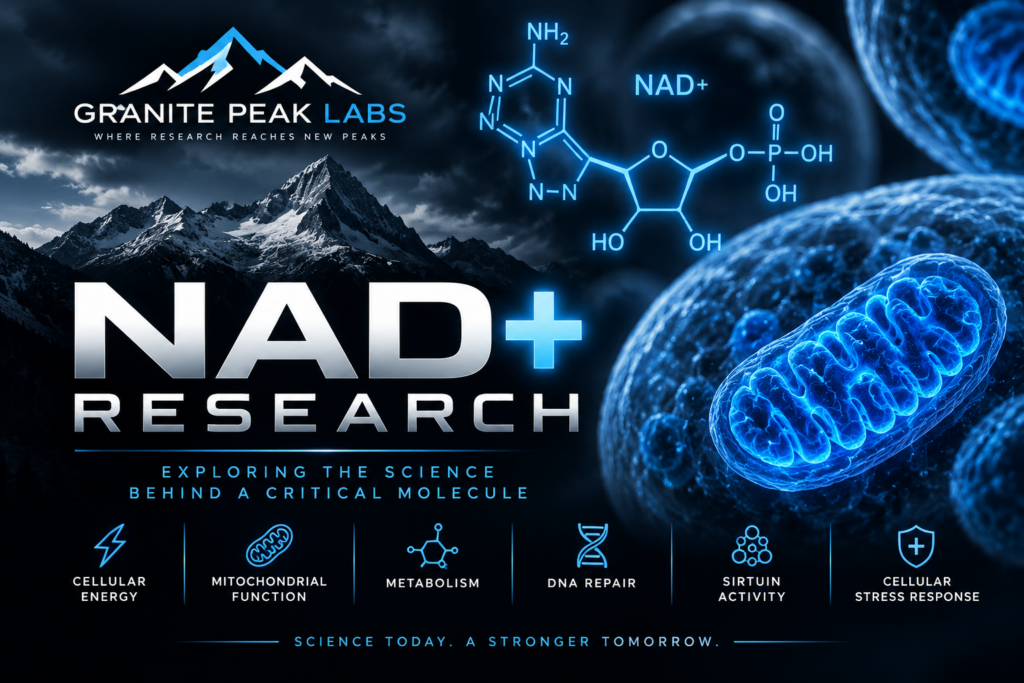
Researchers study NAD+ because of its connections to cellular energy production, mitochondrial function, metabolism, DNA-related processes, sirtuin activity, and cellular stress responses. Rather than being involved in just one pathway, NAD+ participates in a complex network of biological processes that scientists are still working to fully understand.
This is also what makes NAD+ research so interesting. Even though scientists have understood some of its basic functions for many years, new research continues to explore how NAD+ is produced, consumed, transported, and regulated within cells.
As with any area of scientific research, it is important to separate what has been demonstrated from what is still being investigated. Continued research will help provide a clearer understanding of NAD+ and its many roles in cellular biology.
Research Use Disclaimer
Granite Peak Labs products are intended strictly for laboratory research purposes only. They are not intended for human or animal consumption, medical use, diagnostic use, or therapeutic use. Information presented in this article is provided for educational purposes and discusses published areas of scientific research. References to biological mechanisms or research findings do not represent claims regarding the intended use or effects of Granite Peak Labs products.
Scientific References
Covarrubias, A. J., Perrone, R., Grozio, A., & Verdin, E. (2021). NAD+ metabolism and its roles in cellular processes during ageing. Nature Reviews Molecular Cell Biology, 22, 119–141.
View the study Katsyuba, E., Romani, M., Hofer, D., & Auwerx, J. (2020). NAD+ homeostasis in health and disease. Nature Metabolism, 2, 9–31.
View the study Lautrup, S., et al. (2024). Roles of NAD+ in health and aging. Cold Spring Harbor Perspectives in Medicine, 14(1), a041193.
View the study on PubMed Demarest, T. G., et al. (2022). Fueling genome maintenance: On the versatile roles of NAD+ in preserving DNA integrity. DNA Repair, 116, 103378.
View the study on PubMed Xie, N., et al. (2020). NAD+ metabolism: Pathophysiologic mechanisms and therapeutic potential. Signal Transduction and Targeted Therapy, 5, 227.
View the study