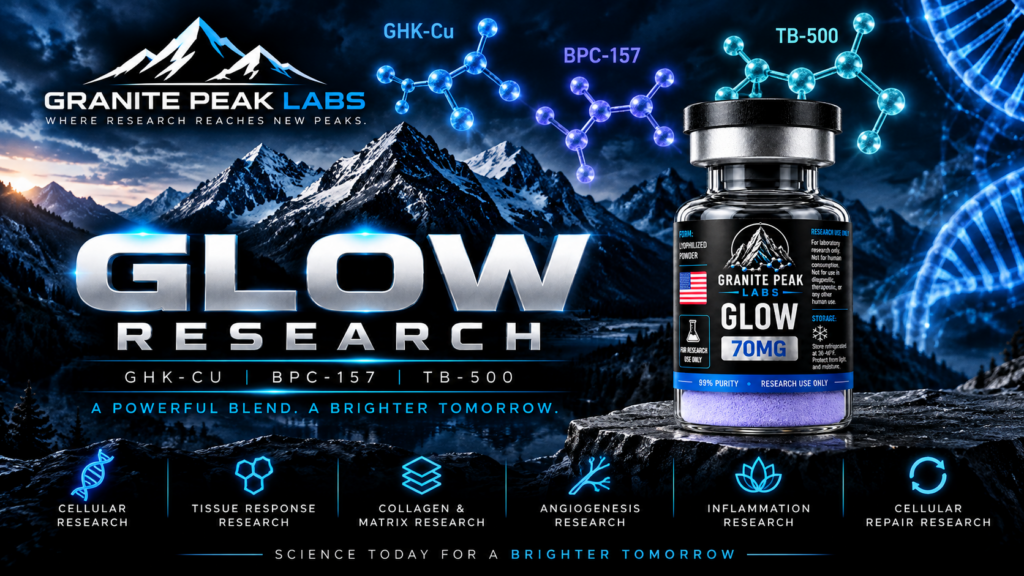
If you have been reading about peptide research, you may have come across a blend commonly called GLOW.
GLOW Research is becoming an interesting area of peptide study because GLOW combines three well-known research compounds: GHK-Cu, BPC-157, and TB-500. Each has been studied separately for different biological processes, while researchers are also interested in understanding how these compounds may interact when studied together.
Put simply, much of the research surrounding these compounds asks questions such as:
How do cells repair themselves? How does the body create new blood vessels? How do cells communicate when tissue is damaged? And what role do peptides play in those processes?
Let’s break down what scientists currently know and why these compounds continue to receive research attention.
What Is GLOW?
GLOW is a combination of GHK-Cu, BPC-157, and TB-500.
GLOW Research focuses on understanding how these three compounds may interact in controlled laboratory settings.
These compounds are grouped together because researchers have studied them in areas that can overlap, including cell communication, blood vessel formation, inflammation, and the way tissues respond to damage.
An easy way to understand the idea is to think of tissue repair as a construction project.
One crew might remove damaged material. Another delivers supplies. Another builds new structures. Another coordinates the entire project.
Biology works in a similarly complicated way. There isn’t one single process responsible for everything.
Researchers study peptide combinations like GLOW to better understand how several of these biological “crews” may work together.
What Is GHK-Cu?
GHK-Cu is a small peptide that naturally binds to copper.
It is actually found naturally in the human body, including in blood and other bodily fluids.
Scientists have been interested in GHK-Cu for decades because laboratory research has connected it with several important cellular processes.
One major area of research involves collagen.
Most people know collagen as something associated with skin, but collagen is actually an important structural protein found throughout the body. You can think of it as part of the framework that helps give tissues their structure.
Researchers have studied how GHK-Cu may influence collagen production and other parts of the material surrounding our cells.
Scientists have also investigated GHK-Cu’s relationship with gene activity, inflammation, cell movement, and tissue remodeling.
That wide range of research is one reason GHK-Cu continues to attract scientific attention.
What Is BPC-157?
BPC-157 is another experimental peptide that has received considerable research attention.
Much of what scientists currently know about BPC-157 comes from laboratory and animal studies, rather than large human clinical trials.
Researchers have studied BPC-157 in experimental models involving the digestive system, blood vessels, muscles, tendons, and other tissues.
One interesting area of research involves blood vessel formation.
Blood vessels deliver oxygen and nutrients throughout the body. When scientists study how tissues respond to damage, they are often interested in understanding how blood vessels respond as well.
Researchers have also looked at how BPC-157 interacts with different chemical signals within the body.
The important thing to remember is that promising results in laboratory or animal research do not automatically mean the same results will occur in people.
What Is TB-500?
TB-500 is associated with research involving a naturally occurring peptide called thymosin beta-4.
One reason scientists are interested in thymosin beta-4 is its relationship with a protein called actin.
You don’t need a biology degree to understand why that’s interesting.
Actin helps cells maintain their shape and plays an important role when cells need to move.
Imagine a cell having its own internal framework. Actin is part of that framework.
Scientists have studied thymosin beta-4 in research involving cell movement, blood vessel formation, inflammation, and tissue response.
These processes are particularly interesting to researchers studying how cells react when their environment changes.
Why Put These Three Compounds Together?
This is where GLOW Research becomes especially interesting.
GHK-Cu, BPC-157, and TB-500 aren’t all being studied for exactly the same reason.
Instead, their areas of research sometimes overlap.
For example, imagine researchers are studying how damaged tissue responds.
Several things may need to happen. Cells need to communicate. Certain cells may need to move. Blood vessels may respond. Structural proteins such as collagen may change. Inflammatory signals may increase or decrease.
Rather than looking at only one piece of that puzzle, scientists can study multiple compounds to better understand how different biological processes might interact.
That doesn’t mean combining three compounds automatically makes them more effective.
It simply creates another research question to investigate.
GLOW and Collagen Research
Collagen is one of the most abundant proteins in the human body. This is one reason GLOW Research has become interesting when examining collagen and extracellular matrix activity.
Think of collagen as part of the body’s structural support system. It helps provide strength and structure to things like skin, tendons, ligaments, bones, and other tissues.
GHK-Cu has been studied for its relationship with collagen and the material surrounding cells.
Scientists are interested in understanding whether GHK-Cu influences the signals that tell cells when to produce, break down, or reorganize these structural materials.
This is one reason GHK-Cu has become particularly well known within peptide research.
GLOW and Blood Vessel Research
Another important research area involves angiogenesis.
The word sounds complicated, but the idea is simple.
Angiogenesis means the formation of new blood vessels from existing blood vessels.
Another area of GLOW Research involves studying the biological signals associated with blood vessel formation.
Blood vessels are essentially the body’s delivery system. They transport oxygen and nutrients to tissues while helping remove waste products.
Researchers have studied both BPC-157 and thymosin beta-4 in connection with processes involving blood vessels.
Scientists want to understand the chemical signals that tell blood vessels when and where to grow and how those signals interact with other cellular processes.
GLOW and Cell Movement
GLOW Research can also help scientists investigate the processes involved in cellular movement and communication.
Cells aren’t always stationary.
Certain cells need to move as part of normal biological processes.
This is called cell migration.
Think about a road crew responding to a damaged road. Workers and equipment have to travel to the damaged location before repairs can begin.
Something somewhat similar happens at the cellular level. Cells receive signals that can influence where they move and what they do once they arrive.
Thymosin beta-4 has attracted research interest partly because of its relationship with actin, which helps cells move and maintain their structure.
Understanding cell migration helps researchers learn more about how tissues develop, respond to changes, and repair themselves.
GLOW and Inflammation Research
Most people hear the word inflammation and immediately think it is bad.
But inflammation is actually a normal part of biology.
When something changes or tissue becomes damaged, the body uses chemical signals to coordinate a response. Inflammation is part of that process.
The problem is that inflammation is extremely complicated.
There isn’t one simple “inflammation switch.” Many different cells and chemical signals are involved.
Researchers have investigated both GHK-Cu and BPC-157 in experimental models involving inflammation and related cellular signals.
Understanding those signals could help scientists learn more about how cells communicate during stress, injury, and recovery.
Why Are Researchers Interested in GLOW?
The biggest reason is that biology doesn’t happen one process at a time.
Cell movement, blood vessel activity, inflammation, collagen production, and cell communication can all occur together.
GHK-Cu, BPC-157, and TB-500 have each been investigated in connection with some of these processes.
Combining them gives researchers another way to study how these biological systems may interact.
It also creates more questions.
Does one compound change the way another behaves? Do they affect completely different pathways? Do some of their effects overlap?
Those questions can only be answered through carefully controlled scientific research.
Does GLOW Have Proven Human Benefits?
This is where it’s important to separate research findings from internet claims.
You may see websites or social media posts making very specific claims about what peptides such as BPC-157, TB-500, or GHK-Cu can do for people.
Scientific research doesn’t always support those claims.
A study showing an interesting result in cells or laboratory animals is not the same thing as a large, controlled clinical trial demonstrating that something is safe and effective in humans.
Researchers use early studies to understand how compounds work and determine whether additional GLOW Research makes sense.
That’s why phrases such as “research suggests” and “scientists are studying” matter.
There is still a great deal scientists don’t know about these compounds, particularly when they are combined.
Why Is GLOW Research Important?
Peptides give researchers another way to study how cells communicate.
Think of peptides as tiny biological messages. They can help researchers investigate what happens when certain cellular signals are increased, decreased, or changed.
The three components associated with GLOW have attracted attention in several areas of research:
GHK-Cu — collagen, cellular signaling, and tissue structure.
BPC-157 — tissue-response, blood vessel, and cellular signaling research.
TB-500 — cell movement, actin, and blood vessel research.
Putting them together allows scientists to ask how these different areas might connect to GLOW Research
And that’s ultimately what research is about: asking questions, testing them under controlled conditions, and following the evidence.
Research Findings vs. Human Benefits
One of the most important things to understand about peptide research is the difference between something scientists are studying and something proven to work in humans.
They aren’t the same thing.
Laboratory research can show scientists how a molecule behaves inside a cell. Animal research can help scientists understand how complicated biological systems respond.
Human clinical research requires another level of evidence.
Therefore, findings involving GHK-Cu, BPC-157, thymosin beta-4, or related compounds should not automatically be interpreted as proof of a particular effect in people.
This distinction is especially important when reading information about peptides online and GLOW Research.
The Bottom Line on GLOW Research
GLOW brings together GHK-Cu, BPC-157, and TB-500, three compounds that have attracted scientific interest for different reasons.
Researchers have studied them in areas involving collagen, cell communication, blood vessels, cell movement, inflammation, and the way tissues respond to damage.
What makes GLOW interesting from a research perspective is that these processes are connected.
Instead of thinking about tissue biology as one simple pathway, imagine dozens of systems communicating and responding at the same time.
Researchers are trying to understand those connections.
As GLOW Research continues to develop, scientists may gain a better understanding of how these different cellular processes interact.
There is still much to learn, particularly about what happens when these compounds are studied together. That’s exactly why continued controlled research is important.
Scientific References
GHK-Cu
Pickart, L., Vasquez-Soltero, J. M., & Margolina, A. (2012). The human tripeptide GHK-Cu in prevention of oxidative stress and degenerative conditions of aging: Implications for cognitive health. Oxidative Medicine and Cellular Longevity, 2012, 324832.
BPC-157
Sikiric, P., et al. (2018). Novel cytoprotective mediator, stable gastric pentadecapeptide BPC 157. Vascular recruitment and gastrointestinal tract healing. Current Pharmaceutical Design, 24(18), 1990–2001.
Thymosin Beta-4
Goldstein, A. L., Hannappel, E., & Kleinman, H. K. (2005). Thymosin beta-4: Actin-sequestering protein moonlights to repair injured tissues. Trends in Molecular Medicine, 11(9), 421–429.
Thymosin Beta-4
Philp, D., Goldstein, A. L., & Kleinman, H. K. (2004). Thymosin beta-4 promotes angiogenesis, wound healing, and hair follicle development. Mechanisms of Ageing and Development, 125(2), 113–115. DOI: 10.1016/j.mad.2003.11.005.
Thymosin beta-4 study on ScienceDirect
Research Use Disclaimer
GLOW is intended strictly for laboratory research purposes. It is not intended for human or veterinary use, diagnosis, treatment, cure, or prevention of disease. Information presented here is for educational and scientific purposes and should not be interpreted as medical advice or evidence of safety or effectiveness in humans.